Skip to content

Reviews

2026 Best Hotel Electronic Locks for Global Buyers?

Choosing the right Hotel Electronic Locks in 2026 requires more than comparing prices, finishes, or mobile-app features. Global buyers must examine battery life, emergency access, audit trails, installation demands, and compatibility with property-management systems. A lock may look modern, yet fail during a network outage or create delays at a busy reception desk. Real hotel experience matters here. Guests notice small details, including a reader that responds quickly and a handle that feels solid.

Hospitality security consultant John T. Bowen has said, “Security is a basic expectation, not a luxury.” That principle remains useful for every hotel buyer. The strongest systems protect rooms quietly while supporting smooth operations. They should also help staff identify unusual access activity without collecting unnecessary guest information. Cybersecurity deserves equal attention. So does physical durability. Coastal hotels may face salt air, while mountain properties face cold temperatures and unstable connectivity. One solution rarely fits every building. That is easy to overlook.

This guide reviews the 2026 best Hotel Electronic Locks for global buyers through a practical E-E-A-T lens. It considers field reliability, supplier expertise, transparent certifications, service coverage, and lifecycle cost. Some popular features may be less valuable than expected. A careful buyer should test real doors, not only read product brochures. That extra step can expose weak batteries, poor reader placement, or confusing staff procedures before guests do.
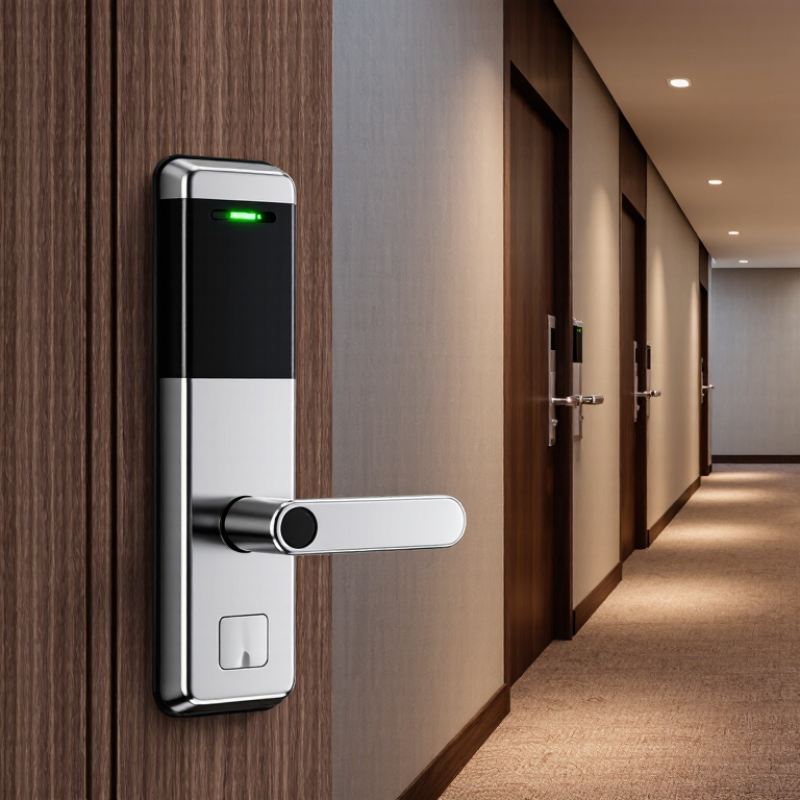
2026 Best Hotel Electronic Locks for Global Buyers?

What Are Hotel Electronic Locks and How Do They Work?

Hotel electronic locks replace a metal key with a digital identity check. A guest presents an RFID card, mobile credential, or PIN. The reader sends the credential to an internal controller. If permissions match, a small motor releases the deadbolt. Access can be limited by room, date, and time. The lock also records entries, failed attempts, and battery levels. It is access control, not merely a modern door handle.

Fortune Business Insights valued the global smart-lock market at approximately USD 2.69 billion in 2023. Its report projects substantial growth through 2032. Grand View Research also forecasts strong expansion, with a reported 19.6% compound annual growth rate from 2024 to 2030. These figures cover several sectors, not hotels alone. Their different market definitions deserve careful attention. Hotel buyers should not treat every forecast as a guaranteed result.

In daily operation, the property system creates a digital credential after check-in. Staff can cancel it instantly when a guest checks out. Wireless systems may update doors through gateways, while offline locks synchronize during card encoding. Battery warnings need practical monitoring. A dead battery can create a stressful hallway scene. Encryption, audit logs, and controlled administrator access support safer operation. Still, no electronic lock is perfect. Poor installation, weak procedures, or lost devices can defeat expensive hardware. The most reliable evaluation includes fire-safety requirements, emergency access, network resilience, and tested maintenance routines.

Which Hotel Electronic Lock Types Fit Different Property Needs?

Choosing a hotel electronic lock starts with the property, not a feature list. No lock type wins everywhere.

For economy hotels, RFID card locks offer familiar check-in routines, simple replacement, and manageable operating costs. They suit corridors with steady guest traffic and reception teams needing quick card encoding.

Boutique hotels may prefer keypad locks when room design matters and guests value a keyless arrival. However, exposed keypads need regular cleaning and careful lighting checks.

Mobile-enabled locks fit resorts and serviced apartments with longer stays. Guests can receive access details before arrival, while managers review entry events remotely. That convenience depends on reliable network coverage, phone compatibility, and a backup process for dead batteries.

For properties with unstable connectivity, dual-mode locks can be safer. They support mobile access but still accept cards or PINs.

Biometric locks may suit staff-only zones, but they require privacy review, enrollment discipline, and clear fallback access.

Retrofit projects deserve extra attention.

Measure door thickness, latch alignment, battery space, and emergency egress requirements before ordering. A technically impressive lock can fail when the old door frame is uneven.

Ask suppliers for test records, access-log protection, battery alerts, and installation training. Teams often underestimate maintenance time. That mistake becomes expensive.

The best choice balances guest experience, security procedures, local safety rules, and total ownership cost. Yet every property should test several rooms first; paper assumptions often break during busy check-in hours.

What Features Should Global Buyers Compare in 2026?

Global buyers should compare electronic locks by measurable performance, not polished demonstrations. Oracle Hospitality and Skift reported that 73% of travelers were interested in automated services that reduce staff contact. That demand supports mobile credentials, self-service entry, and fast room access. However, a glossy touchscreen is not proof of security.

Check whether the lock supports encrypted communication, secure credential expiry, audit logs, and role-based administration. Verizon’s 2024 Data Breach Investigations Report identified credential abuse in 22% of breaches. A buyer should therefore ask how lost phones, copied cards, and former staff credentials are disabled. Test this process on a real door. It should work during a busy evening, not only in a showroom.

Battery warnings, offline operation, and emergency access deserve equal attention. A door may face humidity, dust, luggage impacts, and thousands of daily openings. Compare battery life under heavy use, low-temperature behavior, and replacement procedures. Look for compatibility with the property-management system and common access protocols. Independent testing and recognized safety certifications add credibility, but certificates do not replace field trials. I would also inspect accessibility: handle height, visual indicators, and simple instructions matter to guests with different abilities. Some specifications remain vague, and that should concern buyers. Ask for failure records, warranty terms, software-update policies, and local technical response times before approving a global rollout.

2026 Best Hotel Electronic Locks for Global Buyers? - What Features Should Global Buyers Compare in 2026?

Global hotel electronic lock comparison matrix for new-build, renovation and multi-property projects
Comparison Criterion Contactless Card Lock Mobile-Access Lock PIN-Code Lock Hybrid Online Lock
Primary credential Contactless guest card or key fob Smartphone application using Bluetooth Low Energy Numeric PIN entered on a keypad Card, mobile credential, PIN or configured combination
Best-fit property Hotels requiring familiar and simple guest access Mobile-first hotels and properties reducing physical key distribution Serviced apartments, villas and short-stay accommodation Large or multi-site hotels requiring centralized control
Offline operation Usually available; access rights are stored locally Usually available after credential provisioning; confirm phone and lock behavior Available when valid PINs are stored locally Normally available as a fallback, but depends on system design
Real-time monitoring Not normally available without an online gateway Available when connected to a compatible gateway or mobile network Limited unless connected to an online management platform Designed for centralized event reporting and remote administration
Typical audit trail Events may be stored in the lock, card encoder or management software Credential issue and unlock events can be recorded when supported by the system PIN use can be logged if the lock has memory or online connectivity Centralized logs with user, door, time and event information, subject to configuration
Guest convenience High; guests receive a physical credential at check-in High for guests with compatible smartphones and sufficient battery power High for guests who prefer not to carry a card or use an app Very high when multiple credential choices are enabled
Credential security Use encrypted credentials and avoid outdated low-security card technologies Require secure pairing, encrypted communication and revocable digital credentials Require unique, time-limited PINs and protection against repeated guessing Should support role-based administration, encryption and immediate credential revocation
Common wireless technology Contactless radio, commonly based on 13.56 MHz card technology Bluetooth Low Energy; some systems add Wi-Fi, cellular or gateway connectivity Often no wireless connection in basic installations Contactless and Bluetooth access with a gateway, Wi-Fi or other network connection
Battery considerations Battery life commonly depends on door traffic, reader type and battery capacity Mobile communication and frequent wireless activity can increase battery consumption Keypad type, backlighting and usage frequency affect battery life Online communication can increase maintenance frequency; low-battery alerts are important
Emergency access Specify mechanical override, external power contact or emergency credential Specify emergency power and a non-phone fallback for depleted devices Specify mechanical override or protected emergency power input Should include local emergency operation even if the network is unavailable
Fire and life-safety integration Confirm compatibility with the building’s fire strategy and egress requirements Confirm fail-safe or fail-secure behavior where required by local code Must not obstruct required escape routes or emergency unlocking Require documented integration with access control and life-safety systems
Door compatibility Check mortise, latch, door thickness, handing, frame clearance and escutcheon size Check the same mechanical factors plus signal strength and gateway placement Check keypad clearance, door handing and suitability for outdoor exposure Check mechanical fit, network coverage and installation requirements for every door type
Environmental protection Select an enclosure rating suitable for interior or exterior installation Verify temperature, humidity, corrosion and water-resistance specifications Outdoor keypads require suitable ingress and corrosion protection Verify both lock and network hardware ratings for the local climate
Hotel software integration Look for documented integration with the property-management system Require mobile-key APIs, identity controls and property-management integration Require automated PIN creation, expiry and synchronization where needed Prioritize open APIs, multi-property administration and real-time synchronization
Data privacy requirements Minimize stored guest data and define retention and deletion procedures Assess location, identity, consent, retention and cross-border data processing Avoid storing unnecessary personal information with PIN records Require access controls, encryption, auditability and a documented data-processing model
Recommended buyer priority for 2026 Secure contactless credentials, easy re-encoding and strong offline reliability Interoperable mobile access, secure APIs, fallback credentials and battery alerts Time-limited PINs, anti-guessing controls, weather protection and emergency override Cybersecurity, open integration, centralized administration, offline resilience and lifecycle support
Buyer verification note: Performance, battery life, certifications, fire-rating suitability, encryption method, software compatibility and installation requirements vary by model and jurisdiction. Obtain current technical documentation, cybersecurity information, local compliance evidence and a site-specific installation assessment before purchase.

How Can Hotels Evaluate Security, Compatibility, and Reliability?

2026 Best Hotel Electronic Locks for Global Buyers?

Hotels should assess electronic locks through security, compatibility, and reliability. In practice, a secure lock combines strong encryption, protected access credentials, and detailed entry records. Look for systems that support role-based permissions and fast credential cancellation. This matters when a guest loses a key card at midnight. Test the lock during network outages. Essential functions should remain available without constant cloud access. Review data storage, administrator controls, and privacy safeguards for each operating region.

Compatibility deserves equal attention. Before purchase, confirm the lock fits existing doors, cylinders, and fire-safety hardware. Check integration with the property management system and elevator controls. Mobile credentials may improve convenience, but they also depend on phones, batteries, and staff training. Ask for open interfaces and documented installation requirements. A low purchase price can become expensive after repeated door modifications.

Reliability appears during repetitive, uncomfortable testing. Run thousands of locking cycles. Check battery warnings, emergency power options, weather resistance, and performance across temperature changes. Examine the service process, spare-part access, warranty terms, and technician response times. During one pilot, a battery alert arrived too late for several rooms. That small failure exposed a larger weakness in monitoring. Hotels should test real workflows, not only polished demonstrations. Door alignment, housekeeping routines, and night-shift response can change the result. No electronic lock is perfect. A careful buyer records these imperfections before approving a wider installation.

2026 Best Hotel Electronic Locks for Global Buyers

How can hotels evaluate security, compatibility, and reliability?

This illustrative 100-point procurement scorecard prioritizes security, compatibility, and operational reliability. Buyers should validate each category against local building codes, fire-safety requirements, accessibility rules, cybersecurity policies, door hardware specifications, and supplier service capabilities.

What Should Buyers Know About Installation, Support, and Total Cost?

For global hotel buyers, an electronic lock is more than a metal handle. It affects check-in speed, room security, maintenance, and guest confidence. Installation begins with the existing door. Measure door thickness, lock dimensions, frame alignment, and available power points. A lock that fits one room may fail across an older property. Request wiring diagrams, drilling templates, and compatibility data before ordering. Battery access matters. Housekeeping staff need simple procedures during busy room turnovers.

Support should be tested before signing a contract. Ask about remote troubleshooting, replacement parts, training, and response times across different time zones. A reply after 48 hours may be acceptable for a minor software question, but not for a whole floor with unusable locks. Local technicians can reduce delays, although their availability should be confirmed in writing. Keep spare batteries and critical components on site. Software updates also need a controlled process, because rushed updates can interrupt operations.

Total cost includes the lock body, access credentials, gateways, installation labor, shipping, training, batteries, maintenance, and subscription fees. A low purchase price can become expensive after repeated service visits. Calculate costs over five years, not only the first invoice. Request a line-item quotation with warranty limits and replacement terms. In practical procurement reviews, small details often change the budget. I still allow a contingency for damaged doors and unexpected wiring. No forecast is perfect.